Hockey Is No Laughing Matter

No matter what sport you play, you work hard to perform at an elite level. Stereotypes of hockey players being physical and technically sound athletes are both true and a bit of fabrication. Not to say they’re physically weak, some training techniques and methods are just over exaggerated.

Humor is not simply a matter of taste: it is a vehicle by which people articulate and validate their relationships with those whom they share the joke.”

For example, playing hockey in Europe is almost second nature to breathing. A hockey team from Finland filmed a commercial, pretty much fabricating their skills and strength training. With a bit of comedy mixed in.

Finland produces a great deal of talent, but I don’t think any players go out to practice skating full speed into a zamboni. Or do relays at 200 km/h, which is humanly impossible. Producing spreadable content like this displays a playful exaggeration of the training techniques these European players go through to become the best in the world.

The Boston Bruins are one of the most well known hockey teams in the NHL. A few years ago, they created a campaign to express certain “rules” and regulations fans should follow. I think we’ve all fallen victim to one or two of them before. Watch below to find out:

I don’t know about you, but I’ve definitely been guilty of leaving the game early. The train is always crowded and it’s not comfortable if you’re claustrophobic. If you tuck in your jersey, it’s just not normal I’m sorry. Well not really. For diehard hockey fans, most of these “rules” hit home because it’s almost like a lifestyle. Bruins fans don’t associate with Canadiens or Maple Leafs fans. That’s just a fact.

Whether or not you follow hockey, this commercial campaign gives you an idea of how to behave at the game. Should you find yourself at one, that is. If you are able to go to a playoff game in the next couple of weeks…I’d run through these rules again so you don’t feel out of place.

With the Stanley Cup Playoffs in full swing, fans like myself are on the edge of their seats. Which makes me curious…Who is your pick to win the Cup? Sound off in the comments below!!

Start ‘Em Young

I don’t know from experience, but I’m pretty sure being a parent for the first time is scary. How do you prepare to be a parent though? You read books and learn techniques from your parents to see what is effective in raising a child at each stage of their life. Teaching your kids new sports is kinda similar. If they like sports, you have to let them grow to favor one organically if they decide they want to play it.

Tips For Brand-New Hockey Parents:

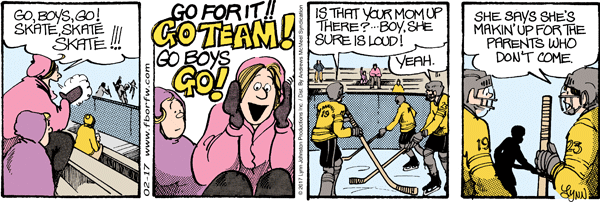
  • IT’S JUST A GAME!!! The one thing I find most common, mostly at my sister’s games, is that parents are more into winning than the kids. I get it. You want your son/daughter to play well and get enough ice time. But screaming at the coach isn’t gonna solve anything, Dad. I can assure you no medals or trophies will be given out at the first preseason game. Settle down.
Credit: Steve Nease
  • Be Positive, But Realistic. You should always support your son/daughter in any aspect of their life, but there’s limitations sometimes. If they are playing hockey and say they want to be in the NHL, great. Support that dream of theirs. Most of the time, the kids playing the sports feed off of the feedback of the parents. Fluctuate your critique, it generates hard work and improvement. Nothing crushes a child more than disapproval from their parents. Make them confident but keep them grounded.
  • Learn The Rules, Know the Game. Nobody likes the person who has no idea what’s going on. As a hockey parent, or any sport really, you should have a general understanding of the rules. That way, if your son/daughter gets a penalty, you won’t look so silly yelling at the refs. Unless you’re my father at which point it’s second nature. So read up on your child’s athletic interests, avoid any weird looks from other parents.
  • SAVE YOUR MONEY! I cannot stress this point enough. If your son or daughter wants to play hockey, don’t buy them expensive equipment yet. As they get older, maybe consider it. You aren’t improving your kid’s success rate with new $700 skates at 5-yrs. old. There are many elements to the “outfit” of a hockey player. Helmet, knee pads, shoulder pads, pants, skates, socks, gloves, stick(s)…are you broke yet? Please for the love of God, if your child is starting out, buy secondhand skates and other pieces of equipment. They aren’t ending up on the new CCM or Bauer hockey magazine anytime soon. Be smart about your money, skates are skates. Just don’t buy figure skates by mistake.

Color Doesn’t Matter Unless It’s Gold or Silver

Being born into a hockey family, I was conditioned to root for Team USA during the Olympics. Team Canada was the enemy by default but I didn’t really stop to think about why?

Aside from the Olympics, the International Ice Hockey Federation (IIHF) World Championship is a pretty big deal. It’s basically like the minor league Olympics. When I first read this article, I honestly thought that Sarah Nurse was about to play with the guys and I was surprised.

Disappointing Numbers

When you look around the ice hockey scene, more often than not the players, both men and women, are white. For example, there are only 27 active players in the NHL who identify as African-American/Canadian or bi-racial.

To put that small number into perspective, there are 620 active players in the NHL. So you can see where the skin complexion overshadows with white. I think the post could touch upon the number of players of color in women’s hockey. This could help the readers research different stats and players beyond Nurse.

Destined for Greatness

Sarah Nurse who is a woman and a woman of color, is pretty much turning heads as she is on her way to represent Team Canada in the IIHF World Championship. I think it’s cool that she comes from a very athletic family. Her brother plays for the Oilers, her sister plays in the WNBA. Her uncle is also Donovan McNabb which is pretty cool, too.

Circling back to playing favorites with Team USA, I was happy to see that we defeated Team Canada for Olympic gold, whom Nurse plays for. She’s playing with 15 of her teammates from the Olympics. Maybe this time around she can bring home the gold…

Role Model Status

Some people aren’t familiar with the CWHL. Women and young girls who aspire to play professional hockey surely do. I really liked how you introduce Sarah Nurse and her athletic accomplishments as a forward for the Toronto Furies. She’s one of the few women of color in this sport, which is definitely an interesting angle to write on.

Nurse played 26 games for the Furies in the 2018-19 season. She recorded 14 goals and 12 assists.

I like how this post brings attention to the fact that Sarah Nurse is representing her country and that she’s a role model for women and young girls of color. I think that if this were a post about bringing awareness to that fact, it could expand beyond Nurse and profile more African American/Canadian or bi-racial players in women’s hockey.

NHL Extends The Invite, But Not The Paycheck

NHL All-Star weekend showcases the many different skills a player possesses and puts them to the test in head-to-head competition. Every year, the skills challenge is a big event as we see many different challenges such as passing precision, hardest slap shot, fastest skaters, and shooting accuracy. One interesting aspect of this year’s event was that two women were added to the competition: Brianna Decker and Kendall Coyne-Schofield.

I’m sure it comes to no surprise to anyone that seeing women in a men’s league skills competition, that their presence turned a few heads in confusion and curiosity. I for one, was very happy to see some diversity in the skills competition because who’s to say women can’t skate as fast or shoot as well as the guys?

Kendall Coyne participated in the fastest skater event and Decker competed in the Premier Passer competition. In the skating event, Coyne proved her worth as she recorded a time of 14.346 seconds, taking one lap around the rink. Unfortunately, she placed 7th out of 8 competitors, but what I find to be the most important takeaway is that people will remember the name Kendall Coyne.

Now, what would this article be about if there was no substance of controversy? There were eight players who were competing in the passing skills challenge, Brianna Decker performed the demo for the challenge before it began. Many people in the audience were confused because they, along with myself, thought she was competing as well. Evidently she was just giving us a walk through of how it was set up.

The controversial side of this was that whoever finished the challenge the fastest, was awarded $25,000. Brianna Decker had completed the “tutorial” in 1 minute and 6 seconds. The official winner, Leon Draistaitl, had finished the challenge in 1 minute and 9 seconds. I thought it was interesting because the officials only acknowledged an “official” competitor as the winner, which created backlash from fellow players and female athletes alike.

I, along with many other people, found that this was absurd because she should be recognized more than she is for putting up the fastest time. This injustice was not taken lightly as the hockey brand CCM found it only fitting that a few days later they would personally award her the $25,000 she missed out on.

Brianna Decker

CCM served as the social justice warrior in this situation by picking up the pieces of a broken system and making things right with both Decker and the women’s hockey community.

One can hope that next year, the NHL gets it right and extends the invitation to more women players so they can dominate the competition.

Are you Hitting Me?!

When you turn on a hockey game, what’s the first thing you notice? You might say that the puck is too small to see or that everyone’s skating very fast. But the one thing that goes on without even realizing it, is how often the players hit each other. Men’s ice hockey is very physical as it is mainly a test of strength as well as skill. Many players have a role of the “enforcer” which basically means they are paid to hit people and fight. If you watch a women’s ice hockey game, there’s no such thing as an enforcer. Believe it or not, there’s an actual rule against hitting all together. You may find it odd to think that in a game that requires such strength and agility, that women are discouraged to hit one another for their own safety. So why then, are men and women allowed to play the same sport but men are allowed to make contact?

Putting on pads serves only as a formality as injuries can occur for both men and women. You could tell me that women are too weak to protect themselves over a hip check into the boards, and I can give you at least five examples of guys who got laid out in plain sight, no thanks to their helmets or pads. The physicality makes watching the men’s games exciting and the women’s brand suffers due to a lack of contact. Professional women’s leagues are suffering from low ratings because people want to see violence and contact, not this game of respecting personal space.

Denna Laing, a former NWHL forward for the Boston Pride, suffered a career ending injury in 2016 where she crashed hard into the boards chasing the puck. Many people look at this incident and say “this is why women shouldn’t be able to play contact sports!” First of all, she fell into the boards after being tripped up and quite frankly she couldn’t really protect herself that close to the wall. Laing was paralyzed from the neck down following this incident which is cause for concern in the women’s ice hockey community.

Do women lack some gene that makes them incapable to play at a level where physicality isn’t a problem? I would really like to know because from what I can see, aside from incidents on both sides, there seems to be no difference in the pace of play and the level of talent that’s on the ice. Nathan Horton, Denna Laing, Marc Savard are just a few names of players whose careers have ended due to injuries from being hit. It just confuses me because with the lack of contact in women’s hockey there has been one real injury. With men’s hockey, there have been countless open-ice hits, pucks to the face, and other injuries that outweigh the women’s.

Women want to hit and because of the feminine nature surrounding them, they’re told no. In a “male-dominated sport” such as ice hockey, if you aren’t gonna let women compete at the same level and with the same rules, why waste everyone’s time? Elite female hockey players like Hilary Knight and Meghan Duggan compete in the Olympics and train their bodies to absorb hits and use their strength to out muscle their opponents just the same as men. So it makes you wonder, why are these women being held back?

Opening Face-off

Women’s ice hockey is sport that has gained momentum in terms of popularity among young girls and adults alike. The problem however, lies within the fact that the media doesn’t do enough to promote the sport and creates a stereotype that women don’t deserve enough air time because women are not as masculine or athletic as men. Within the landscape of ice hockey as a whole, women are primarily recognized during the Olympics. Within the 4-year gap between events, how are they represented in the media? I plan to explore this dilemma further in understanding why women aren’t given their fair share of publicity.

I think it’s important for my readers to get a sense of how the world of sports is evolving and how women are using their voice to stand up and say: “we deserve a chance.” Throughout my publication(s), I want the audience to see through different perspectives, how the media is portraying women’s ice hockey both positively and negatively. I would like to discuss how different men’s ice hockey is from women’s and how the limitations for the women suggest physical inferiority. By using these negative or oppressive stereotypical examples, I believe they will help readers understand how we can turn these issues into solutions.

Throughout this publication, I’m not trying to argue who is better at playing hockey. I think it’s hard to differentiate and compare talent when some people don’t even know that professional women’s hockey exists. Within the realm of gender inequality in ice hockey, I want to limit the focus of weaknesses that women have because my main goal is to build on the fact that these athletes play an elite level and deserve to be seen as equal.

Exploring different aspects and headlines that display gender inequality in women’s ice hockey. For example, I would like to discuss the comparison of salaries between professional female players and NHL players. A lot of the imbalance in who gets paid more is due to airtime and actual visual presence on TV. NHL games are televised on a daily basis which cultivates sponsors and generates revenue, whereas the NWHL gets little to no recognition resulting in far less capital. I want to talk about how the lack of media recognition, outside of the Olympics, hurts women and their sport because they’re seen as less interesting than men.

Outside of the sport of ice hockey, I’ve become a firm believer in the idea that women deserve the same rights and opportunities that men have. I’ve been inspired to explore this issue within the world of ice hockey because my sister is a female hockey player. She feeds off of people’s criticism that girls are too frail or unathletic to play hockey. When my sister was little, she wanted to learn how to skate and be like the boys. She had to join the boys youth teams because there were no girls teams around. This is inspiring to me because I want to help uncover this “hidden” sport and use my source of inspiration as a role model for other little girls to defy gender norms.

As I continue with this publication, I would ideally want my audience to target young women who feel like there isn’t a chance for them to play a sport that they are interested in. I think this topic can bring to light the issues that derogate this the athletes who play this sport and the women who are ambassadors for this sport whom I will talk about as well, can act as a beacon of hope for aspiring female hockey players. I think my audience could also extend to parents and adults who believe women hockey players deserve the same opportunities as men or “athletic feminists”.

Women’s ice hockey is a growing sport in the world but just how much of it do we know? A lot of the unfamiliarity comes from the idea that media does not cover enough of women’s sports in general and specifically ice hockey, due to it’s masculine and physical nature. I believe it’s crucial for sports fans to understand this injustice that women are being overlooked because they aren’t as talented and can’t generate revenue or ratings outside of the Olympics. By addressing the problem that women are not treated or seen as equal to the men in this sport both physically and journalistically, we can inspire change and spread awareness to the fact that women are just as talented as male hockey players and deserve the same amount of attention and respect.